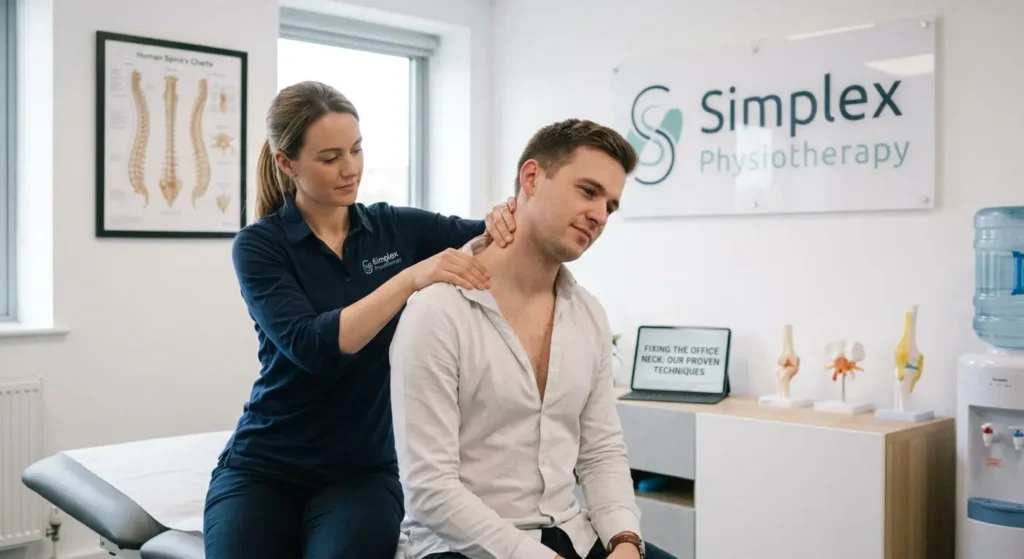
How workers in the Melbourne CBD can get a handle on their posture and reduce their pain by the ‘Corporate Epidemic of Office Neck’.
If you walk down Collins Street, Bourke Street or any corporate lobby in the Melbourne CBD at about 5:00pm, you will see a commonality. Professionals have their shoulders rounded, head tilted back or are rubbing the base of their skulls. As a corporate lawyer, financial analyst, or software developer, or office administrator who sits a lot at a desk, you’re probably all too familiar with this discomfort. It’s often called “office neck” and is one of the most common complaints we see in SimpleX Physiotherapy. Although it may be a minor irritating or dull ache on Tuesday afternoon, if left untreated, the office neck can escalate into chronic tension headaches, intense muscle spasms and a long-lasting problem of the cervical spine.
This extensive guide will break down the precise anatomy of the office neck, discuss how to put together the perfect ergonomic desk setup, examine useful daily habits to start today and lay out the ways in which focused physical therapy can interrupt the vicious cycle of persistent stiffness.

The Biomechanics of “Office Neck”: Why Your Desk is Hurting You
First, let’s get a better grasp of the physics of your posture so you can see how to fix the office neck. The average weight of an adult human head is about 4.5 – 5.5 kg in a neutral, upright position. Your cervical spine and its supporting muscles are just right to bear this weight and do it with very little effort. During these posture changes, however, your head will move forward of your center of gravity, which can cause fatigue and strain. This is called a “Forward Head Posture. The weight of your head on your neck becomes approximately 12kg when you tilt your head forward slightly (15 degrees).
At a 30 degree incline, that weight actually doubles to 18kg. At 60° in front, the angle that’s common when you’re checking your phone or laptop lying flat on a desk, you’re putting an incredible 27 kilograms of force on your neck. Now imagine that you have a heavy 27kg gym weight around your neck, and you leave it on your body for 8 hours a day, 5 days a week. The body just cannot handle such stress. The muscles at the back of your neck and upper shoulders need to be in chronic low level contracture, so that your head doesn’t fall onto your chest. This continuous tension over several months or years produces painful knots in the muscles, stiff joints and a shift in your entire upper body.
Recognizing the Red Flags: Signs to NOT Ignore
Office neck doesn’t just happen in one day. It starts as a whisper, and then it’s a roar. Early signs that many CBD workers ignore are simply viewed as “just stress” or “normal desk fatigue. If you have any of the below symptoms, your cervical spine is screaming for intervention!
- The most typical sign is the ‘coat hanger’ pain pattern. It is a deep, constant ache in the roof of your shoulders, running up the neck and down between your shoulder blades, in the outline of a coat hanger.
- Another big warning sign is a sudden occurrence of cervicogenic headaches; tension headaches that come from tight muscles and compressed joints at the bottom of your skull. These usually feel like a tight band around the forehead or as if there is a “thumping” pressure behind one eye.
- There may also be a significant decrease in cervical movement. This can manifest as head turning problems (e.g. during a driver’s check of the blind spot while driving down the Monash Freeway) or the inability to comfortably reach the chin to the chest. Lastly, watch for neurological signs.
If your arm and hand are tingling or numb, “pins and needles,” or going down your arm, it means the tightness of your muscles is irritating a nerve root coming off of your spinal cord or a bulging disc.
The Ultimate Ergonomic Blueprint for Melbourne CBD Workstations.
Posture correction is often thought of as sitting straight up like a soldier for long periods of time. This is a myth. If the wind is forced static, it will result in another type of muscle fatigue problems. Ergonomics is actually the art of adjusting your surroundings to allow your body to align itself in a relaxed, neutral and supported posture.
Follow this step-by-step template to have a thorough audit of your business or home office:
Your head will follow where your eyes go. If your screen is too low, your head will drop. Adjust the primary monitor screen so the top third portion is at eye level. Your eyes should look naturally on top lines of text when reading straight ahead. Place the monitor about an arm’s length from your face. If it’s too far, you will unconsciously stick your chin out to see small text. If you use two monitors equally, position them so it’s in the middle of your screen.
Ideal Desk Environment: How It Should Be
The laptop lacks ergonomics since the keyboard and the display are directly connected. To see the screen you have to look down, and to be able to use the keyboard at the proper height, the screen drops even further. When working in a “hot-desk” or “hybrid” environment, (where the laptop is used in a variety of different locations around the Melbourne CBD), ensure that the laptop screen is always at eye height by using a portable laptop riser or a stack of sturdy books.
This arrangement can be combined with a separate Bluetooth keyboard and mouse that lie on your desk surface and it is never advisable to type on an elevated laptop. Your shoulders carry your arms and if your arms are unsupported, your upper trapezius muscles will lift them, which will directly cause neck tightness. Make sure your elbows are at a 90- to 100-degree angle while you’re seated at your chair or desk. Sit all the way down under your desk. The distance between your keyboard and mouse is not too far and you’re not leaning forward while you work, causing you to round your shoulders and stretch your neck. Your lower back changes immediately affects your neck.
If your lower back is curved in a “C” shape, your upper back is curved in toward your screen, so you’re forced to hyperextend your neck in order to see the screen. Sit back fully in your chair making sure the curve of the spine is supported by the curve of the chair. In the absence of support, place a special lumbar roll or rolled up towel in your chair. Do not allow your feet to lift off the ground. If your chair is up to accommodate a fixed desk height and your feet are hanging, you will need to have a footrest to stabilize your pelvis and maintain your spine stacked.
Desk Strain Counteract Is A Collection Of Daily micro-Habits
The human body is built to move, it is not designed to sit for hours on end in an ergonomic chair. Frequent movement helps to eliminate wastes from your muscles, improves circulation, and restores joint lubrication. Make these practices a regular part of your work routine. The first thing to do is the 30 minute micro reset. Install a muted timer on your computer.
- Take a break for 15 seconds every half hour.
- Do 5 slow shoulder rolls backward and turn to gaze over the left and right shoulder to abolish static muscle holding patterns.
- Now, do the desk based chin tuck to correct forward head posture.
- Try out chin tucks while sitting at your desk by keeping your head square and looking straight ahead, pulling your head back just as if you were going to form a double chin. Maintain position for 3 seconds, then relax.
- Do this 10 times to tighten and strengthen deep neck flexors that stabilize the head in position.
- Last but not least, use active transport! Melbourne is very walkable, so try to make the most of your daily walks and get your blood pumping. Alight the Metro Train or Yarra Tram before you intend, and walk the rest of the way down the laneways of the city. Phone calls also can be an excuse to stand up and move about the office floor.
When Ergonomics Is Not Enough: How Physiotherapy Breaks the Pain Cycle
While it’s important to fix the desk setup to prevent further injury, it’s not likely to undo years of joint restriction, muscle shortening and neural inflammation. Although manual clinical intervention is the most effective course if already trapped in a painful cycle of office neck, it is feasible in some instances.
We offer full service, hands-on treatment tailored to the working man or woman to help you move without any pain whatsoever at the SimpleX Physiotherapy clinic:
We perform a thorough Postural Assessment to determine the cause of your overcompensation of your body; how your joints move, if your spine is curved, and your muscular imbalance.
- Targeted Manual Therapy & Joint Mobilisation: Gentle joint mobilisations applied to stiff thoracic and cervical joints to help relax restricted thoracic segments, decrease thoracic friction and restore your natural range of motion quickly.
- We use Dry Needling to take out deep, stubborn muscle knots in the upper traps and the neck to get immediate relief from intense muscle spasm, increased blood flow and rapid relief from tension headaches.
- Exercise Rehabilitation & Clinical Pilates: We create personalized stretching plans and apply specific clinical pilates concepts to strengthen your deep core, mid-back stabilizers & neck flexors, making proper posture easy.
Living with chronically tight neck muscles and headaches can’t be a normal part of a corporate career. Your workstation doesn’t have to be a place that takes a toll on your health. So if you’re ready to find out the cause of your desk-related neck and build a resilient body to do office work without problem, our clinical team is ready to guide you.
Contact us at the SimpleX Physiotherapy Contact Page to discuss with our clinical team, or to book your first assessment of your posture today.
Frequently Asked Questions
Q. What is the quickest period of time it takes to repair business neck?
The duration will depend on the length of time that you have been experiencing the strain. If you are suffering from desk fatigue, but not severely, then you can easily improve your ergonomics and perform some light stretches to feel better in as few as two weeks. Most chronic conditions which have developed over a period of months or years will take 4 – 6 weeks of regular physiotherapy, manual therapy and strengthening exercises to permanently end the cycle of pain and restore muscle resilience.
Q. Will an ergonomic chair completely eliminate my neck pain?
A good ergonomic chair can offer critical support to your lower back and help position your pelvis but cannot correct the pain in your neck, on its own. Even if your monitors are still too low, your keyboard is too far away, or you sit completely still for hours at a time, you will still suffer from neck strain. Ergonomics is a whole system solution, which needs to be customized with appropriate adjustments to the layout and regular physical activity.
Q. Is clicking or cracking my own neck bad for me?
Regularly moving your head from side to side to relieve tension is usually not a problem, but often forcing your own head to “crack” or “snap” loudly can cause problems down the road. This self-cracking tends to shift existing hypermobile joints instead of focusing on the stiff joints which need releasing. It may lengthen and make your cervical (neck) ligaments less stable, and can lead to the tightening of the surrounding muscles even more.